
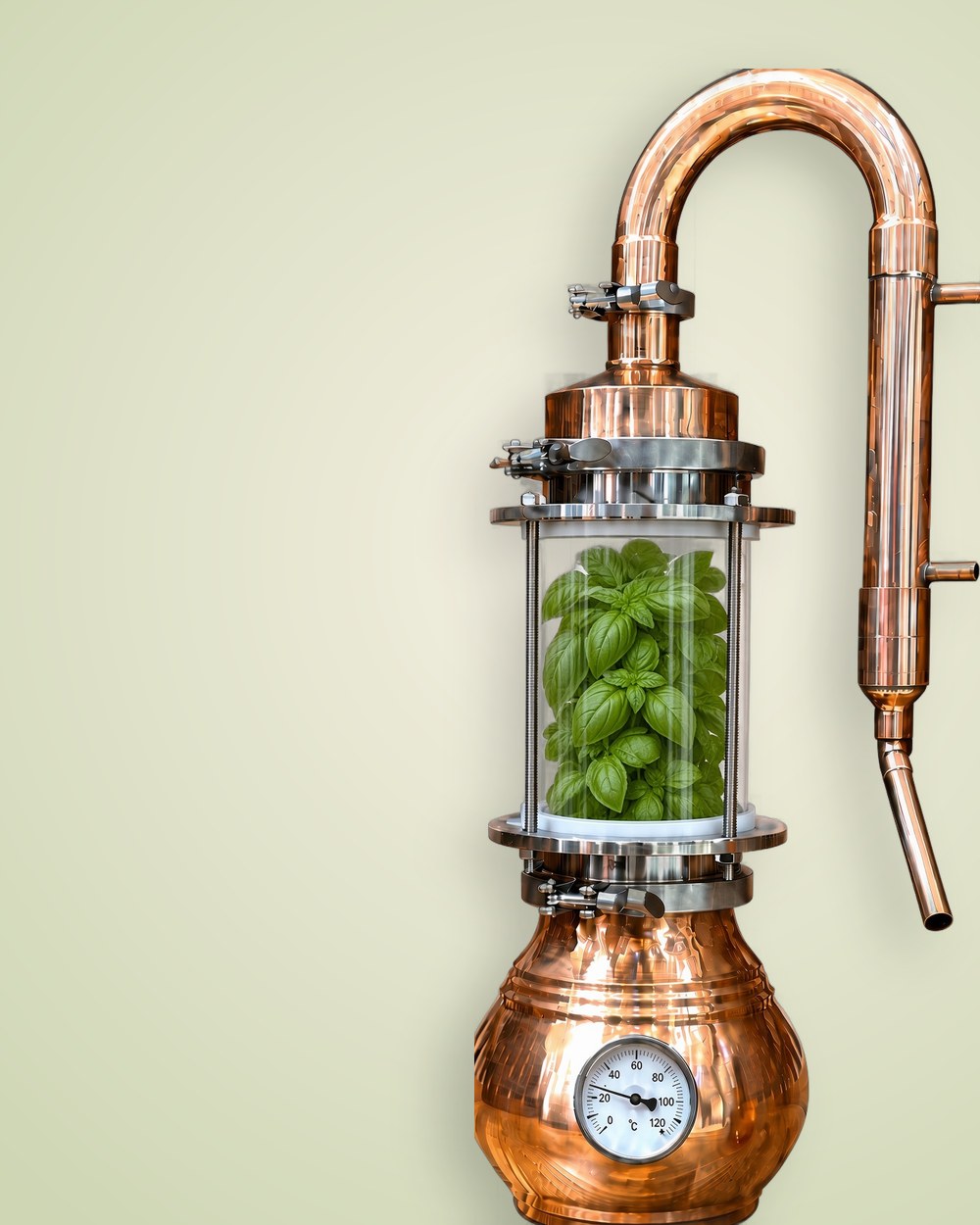
Basil (Ocimum basilicum) is grown all the way from France and Italy to Bulgaria and Egypt, and it is one of the most aromatic herbs you can distill at home. Most people know it from the kitchen, but in a copper still it shows a completely different side.
For distillation you use the whole plant: leaves, stems and flowering tops. The result is a pale, colourless to light yellow oil with a light, sweet and fresh spicy scent, and a hydrosol that smells unmistakably of summer.
The character of the oil comes mainly from two compounds: linalool, which gives the soft, floral note, and eugenol, which adds a warm, clove-like spice. Depending on the variety, you may also notice a hint of citrus.
The most important rule with basil is simple: distill it fresh. Basil leaves are thin and lose their aromatic compounds quickly when they dry. Dried basil that is perfect for a tomato sauce gives a disappointing result in the still. Harvest on the day you distill, ideally in the morning.
Fill the basket loosely and cut longer stems into shorter pieces. The soft leaves collapse quickly in the steam, so a basket that looks full at the start will settle during the session.
Would you distill your basil, or keep it for the kitchen? A few plants in a sunny window can be enough for a small batch.