
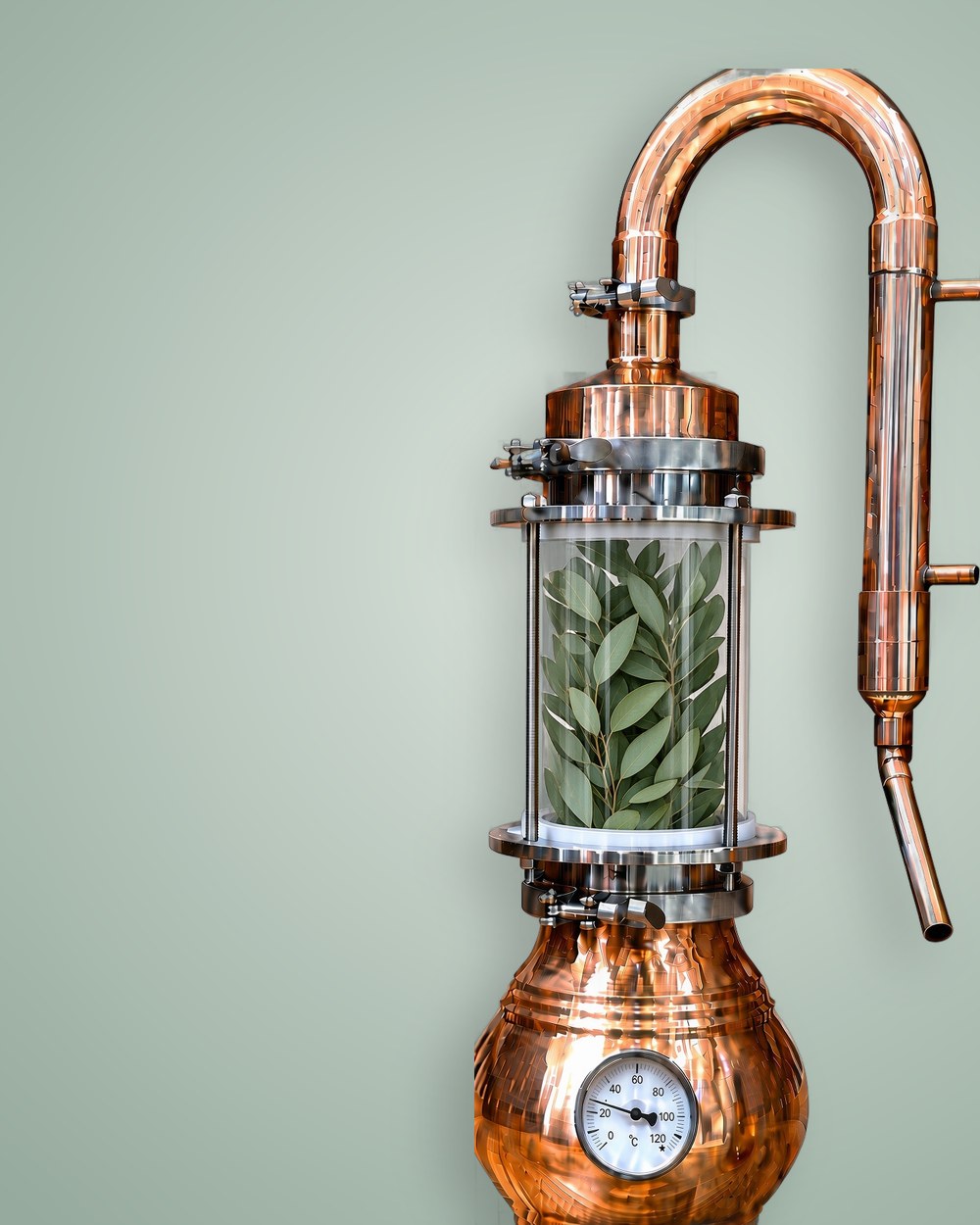
Eucalyptus (Eucalyptus globulus) is native to Australia, where it grows into tall trees with long, silvery green leaves. Today it is also grown in Spain, Portugal, Brazil, California, Russia and China, and it is one of the most widely distilled plants in the world.
For distillation you use the leaves and the young, thin twigs. You can distill them fresh, or let them dry partly first. Half-dried leaves take up less space, so more plant material fits in the basket.
The oil comes out colourless and very fluid, with a fresh, camphor-like and woody scent. Over time it slowly turns pale yellow. Its main component is cineole, also known as eucalyptol, which gives eucalyptus its clean, penetrating character. Pinene, limonene and terpinene round out the scent.
Eucalyptus is a generous plant in the still. The leaves are rich in oil, so even a small batch usually gives a clear layer floating on the hydrosol. The hydrosol itself has the same fresh, clean scent in a softer form.
A practical tip: tear or cut the larger leaves before filling the basket. This opens the oil glands and helps the steam pass through evenly. If you have access to a eucalyptus tree in a garden or park, ask before harvesting, and take only what you need.
Have you ever smelled freshly crushed eucalyptus leaves? It is one of the most refreshing scents to fill a room during a distillation session.