
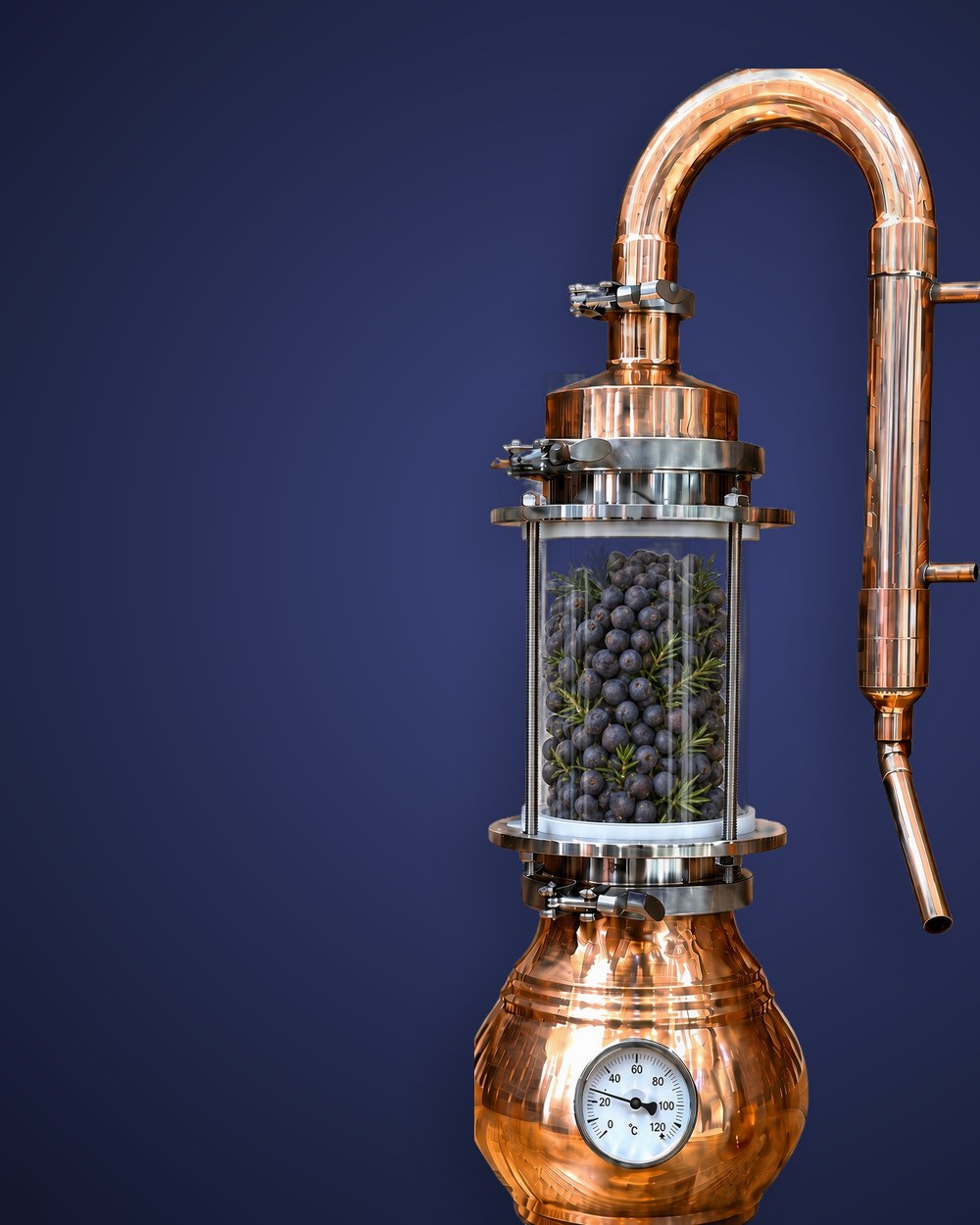
Juniper (Juniperus communis) is the little blue berry that gave Dutch jenever its name. The word jenever comes from jeneverbes, the Dutch name of the plant. Long before it flavoured a famous spirit, juniper was a familiar shrub on the heathlands of the Netherlands.
The plant grows wild across Scandinavia, northern Europe, North Asia and Canada, and it is also cultivated in countries such as Italy, France, Austria, Spain, Germany, Serbia, the Czech Republic and Slovakia.
For distillation you can use the berries, the wood and the needle leaves. Steam distillation gives a clear to pale yellow, very fluid oil with a fresh, woody and balsamic scent. Its main components are terpenes such as pinene, limonene and sabinene, together with cedrol, which adds a soft, woody depth.
The berries are the heart of juniper distillation. They are covered with a waxy, silvery bloom and hold their aroma inside. Crush them lightly before they go into the basket, for example with a rolling pin or in a mortar. This opens the berries so the steam can reach the oil, without turning them into a paste that blocks the steam.
You can combine berries with a handful of needles and small pieces of wood for a greener, more resinous character. The berries can take up to two or three years to turn from green to blue, so you will often see both colours on the same shrub.
Have you ever smelled freshly crushed juniper berries? It is one of the most surprising scents a small still can give.